


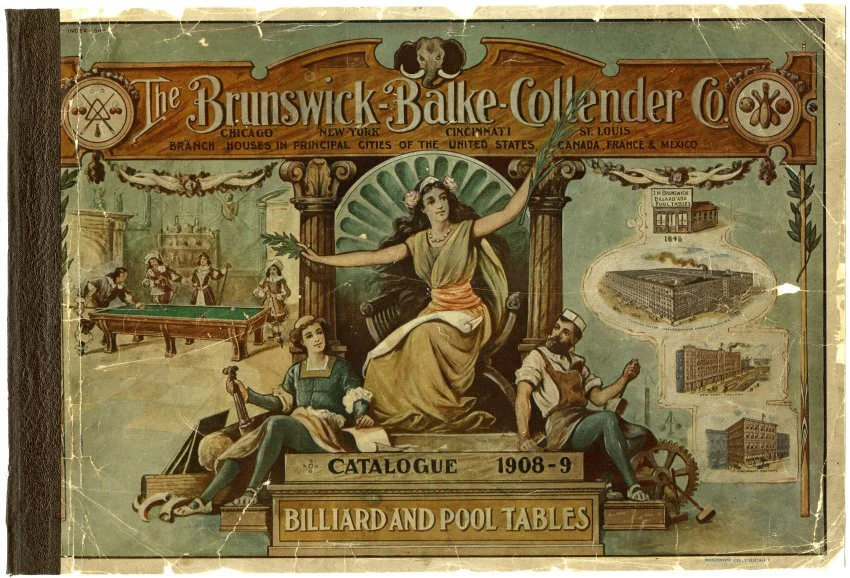
When people talk about the game of billiards in America, one name rises above the rest: Brunswick. For more than 175 years, Brunswick Billiards has represented craftsmanship, innovation, and cultural influence. From its humble beginnings in the mid-1800s to becoming an American corporate icon, the company’s story is intertwined with the growth of billiards, bowling, and recreational culture across the world.
This article traces the Brunswick pool table history, from the visionary founder John Moses Brunswick to the formation of the Brunswick-Balke-Collender Company, through the leadership of figures like Moses Bensinger and Robert Bensinger, and into the modern era.
Along the way, we’ll see how Brunswick’s legacy of adaptability, diversification, and relentless innovation created not only world-class pool tables but also a vast collection of recreational products that shaped the leisure lives of American families.
The Founding of Brunswick Billiards
John Moses Brunswick and His Vision
The Brunswick story begins with John Moses Brunswick, a Swiss immigrant who arrived in the United States as a teenager in the 1830s. At first, he tried his hand at trades like harness making and eventually joined the Cincinnati Carriage Making Company, where he learned woodworking and precision craftsmanship.
In 1845, he encountered a billiards table from a London manufacturer, John Thurston. Enamored with its fine design, Brunswick made a bold declaration: “If it’s made out of wood, we can make it better.” This statement would set the stage for the creation of the J.M. Brunswick Manufacturing Company later that same year.
Originally focused on building carriages, Brunswick quickly pivoted to billiards tables. By producing elegant, American-made tables using high-quality hardwoods like mahogany, reinforced with brass dowels and intricate inlays, Brunswick elevated the game of billiards from a pastime for elites into a broader American tradition. His designs often featured the finest Vermont slate beds for true ball roll and precise leveling.
Early Expansion: From Cincinnati to Chicago
Demand for Brunswick’s pool tables grew quickly. By 1848, the company expanded from Cincinnati to Chicago, the hub of America’s booming Midwest. Brunswick’s reputation spread as its product lines expanded, from standard billiard tables to more ornate designs for saloons, clubs, and private homes.
The company’s tables became known not only for their durability but also for their artistry. Early examples of antique tables survive today in museums like the Chicago Cultural Center and schools like St. Ignatius College Prep, reflecting how deeply embedded Brunswick became in the cultural landscape of the time.
Notably, Brunswick’s clientele included leaders like Abraham Lincoln, whose ownership of a Brunswick billiards table helped elevate the brand’s image. By mid-century, the company was already recognized as setting standards for competitions, ensuring that professional and amateur games alike were played on equipment of the highest quality.
Growth, Mergers, and the Brunswick-Balke-Collender Era
Family and Partnerships
As demand for the company’s tables grew, John Moses Brunswick brought his family into the business, renaming it J.M. Brunswick & Brother by 1860. The company’s slogan proclaimed it “the oldest and most extensive billiard table manufacturer in the United States,” a claim that reflected its reputation for quality and its expanding network of showrooms and distributors.
Competition in the mid-19th century was fierce, with several regional manufacturers vying for leadership in the American billiards industry. Brunswick’s growing influence and dedication to excellence made it a prime candidate for consolidation with other leaders in the field.
Formation of the Brunswick-Balke-Collender Company
In 1874, Brunswick merged with competitor Great Western Billiard Table Manufactory, owned by Julius Balke, forming the J.M. Brunswick & Balke Company. Just five years later, another pivotal merger took place when the company combined forces with the H.W. Collender Company of New York, a leading innovator in cushion technology.
The newly formed Brunswick-Balke-Collender Company (often abbreviated B.B.C. Company) quickly became a powerhouse in the billiards world. Incorporation in 1879 with a capital stock of $275,000 marked it as one of the most successful recreational companies of its day.
By 1884, capitalization rose to $1.5 million, a staggering sum for the era, reflecting just how profitable the billiards industry had become under Brunswick’s leadership.
Diversification of Products and the Innovation Era
The late 19th century was also the period when Brunswick began a remarkable pattern of diversification that would define the company for generations. While billiard and pool tables remained at the center of its identity, the company expanded its product lines to include elaborate saloon fixtures such as soda fountains and ornate mahogany bars with brass inlays.
Innovation and Influence in Billiards
- Product Excellence and Standards: From the start, Brunswick established itself as the industry benchmark for innovation and reliability. The company’s pool tables often featured Vermont slate beds, mahogany frames, and advanced Monarch cushions that enhanced ball response and durability.
- Expansion to International Markets: Brunswick’s global reach extended far beyond the United States. By the late 1800s and early 1900s, the company had opened showrooms not only in major American cities but also in Paris, Mexico City, and Buenos Aires.
- Development of Billiard Balls: One of the most important contributions to the industry came in 1906, when Brunswick began producing billiard balls in Muskegon, Michigan. Before then, cue balls were made from ivory, an expensive and increasingly controversial material. Brunswick introduced composition balls, which were safer, more durable, and consistent in play.
Brunswick’s ability to adapt, from ivory to synthetic materials, was yet another example of its legacy of adaptability and innovation.
This diversification and innovation would eventually extend into early bowling equipment—pins, bowling balls, and accessories—making Brunswick a household name in multiple recreational markets.
By pioneering the use of vulcanized rubber for bowling balls, Brunswick set new standards that changed the sport forever. This was just the beginning of the company’s broader push into recreational products that would eventually include cues, cue racks, and other equipment for pool rooms and American families.

The Bensinger Era and the Challenges of Prohibition
In the late 19th and early 20th centuries, the leadership of the company transitioned to family descendants.
Moses Bensinger and His Influence
Under the direction of Moses Bensinger, Brunswick further expanded its dominance in the billiards industry and pushed into other markets. Bensinger’s tenure marked a period of rapid growth in recreational products, establishing Brunswick not just as a billiards manufacturer but as a multi-faceted entertainment company.
The influence of the Bensinger family extended into the 20th century, with later leaders such as Robert Bensinger taking the reins. Their vision helped the company navigate cultural and economic challenges while keeping Brunswick Billiards firmly positioned as the standard-bearer of the game of billiards.
Adapting to Prohibition
The era of Prohibition in the 1920s created unique challenges for Brunswick. With bars and saloons shuttered, one of the company’s largest markets for billiard tables and ornate saloon fixtures disappeared almost overnight. Instead of collapsing, Brunswick demonstrated its legacy of adaptability by diversifying into new product lines.
The company became a leader in manufacturing soda fountains and refrigeration equipment, products that filled the void left by alcohol service. While pool tables and cues remained part of the business, these additional ventures sustained the Brunswick Corporation through a period that devastated many other entertainment-focused companies.
Continued Innovation in Billiards Products
Even during Prohibition, Brunswick continued to refine its billiard products. In Muskegon, Michigan, the company developed new formulations of composition balls, including the Ivorylene Dark ball introduced in 1934. Rigorous testing methods, such as dropping the balls from rooftops onto steel plates, ensured unmatched durability.
These balls paved the way for future innovations, including the Centennial® Ball, made from cast phenolic resin, which remains a standard in professional and recreational play. Brunswick’s commitment to innovation during tough times reinforced its identity as an American corporate icon.
Brunswick During World War II
When the United States entered World War II, Brunswick once again pivoted to meet the needs of the era.
Supporting the Military
The company supplied more than 13,000 billiard tables and 3,000 bowling lanes to military bases across the country. These installations provided soldiers with valuable recreation and stress relief during wartime, strengthening billiards’ role as a pastime embedded in American life.
Brunswick’s ability to quickly adapt its production lines to meet the needs of the military showcased its resilience and global reach. Pool tables, bowling lanes, and cues became not just games, but morale boosters for service members.
Renewed Popularity After the War
Following the war, thousands of American families sought recreation at home. Brunswick was ready with a wide product collection that included pool tables, bowling equipment, and even new product lines like phonographs and household furniture. Billiards surged in popularity again as returning soldiers brought their love for the game back into pool rooms, community centers, and family basements.
Brunswick Billiards secured its reputation as more than just a manufacturer when it aligned itself with American families and their new suburban lifestyles—it was part of the cultural fabric of the nation.
Brunswick in the Second Half of the 20th Century
The postwar decades brought tremendous opportunities for Brunswick. While billiards and pool tables remained its cornerstone, the company’s diversification into recreational products accelerated. The Brunswick Corporation became a household name not only in billiards but also in bowling, table games, and broader leisure markets.
Expansion into Bowling and Other Recreational Products
In bowling, Brunswick led the way with the development of the automatic pinsetter, which revolutionized the sport by eliminating the need for manual pin boys. Brunswick also manufactured bowling balls, bowling shoes, and other accessories, cementing its position as a leader in both home and commercial recreation. By the 1960s, the Brunswick name was synonymous with bowling alleys across America, with modern centers later branded as Brunswick Zone XL.
But innovation did not stop there.
In 1972, Brunswick introduced the world’s first Air Hockey machine, a product that quickly became a cultural phenomenon. Alongside pool tables and bowling, the company’s growing product lines included table tennis, foosball, and even ventures like laser tag in later years. This expansive product collection illustrated Brunswick’s ability to adapt to changing tastes and maintain relevance across multiple generations.
Brunswick’s Influence on Billiards Culture
Even as the company diversified, billiards remained at its core. The introduction of the Gold Crown™ table in 1961 set a new benchmark for professional play, becoming one of the most iconic designs in pool history. Known for its Vermont slate bed and durable construction, the Gold Crown was the choice for tournaments and serious pool rooms worldwide.
Brunswick also maintained its reputation for crafting luxury pieces, producing ornate antique tables and vintage tables with intricate woodwork, inlays, and durable Monarch cushions. These billiard tables became heirlooms, often passed down in American families and displayed as much for their beauty as for their role in the game of billiards.
The company’s involvement in competitions grew as well. By supporting leagues and helping establish standards for competitions, Brunswick reinforced its influence not just as a manufacturer but as a shaper of the sport itself.
Partnerships and Advocacy
In the 1970s, Brunswick also contributed to the revival of billiards through advocacy and partnerships. In 1976, it helped found the Women’s Professional Billiards Alliance, expanding opportunities for competitive play and drawing new audiences to the sport.
During these decades, Brunswick continued to demonstrate the legacy of adaptability that had carried it through Prohibition and World War II. Whether through bowling alleys, pool rooms, or suburban basements, the company’s tables and recreational products became fixtures of everyday American leisure.
Brunswick Corporation and Beyond
By the late 20th century, the Brunswick Corporation had become a global leader in recreational products. From billiards tables and cues to bowling balls and boating equipment, the company’s reach was vast. At its height, Brunswick’s brand portfolio reflected an unparalleled global reach, extending its reputation well beyond the United States.
Major facilities, such as the factory in Reynosa, Mexico, expanded manufacturing capacity and supported international demand. The brand’s identity as an American corporate icon was matched by its presence in markets across the world.
Recent Ownership Changes
In the 2000s, Brunswick continued to refine its focus. The Brunswick Corporation eventually divested its bowling business—once a cornerstone of its mid-century success—selling it to private equity firm KPS Capital Partners in 2015. The move marked the end of Brunswick’s direct involvement in bowling centers but reflected a sharper focus on its core legacy in billiards.
In 2022, the Brunswick Billiards division itself was acquired by Escalade, Inc., a company specializing in sporting goods and recreational products. Today, under Escalade’s ownership, Brunswick continues to design and manufacture premium pool tables, cues, and game room furniture while preserving the quality and heritage that began with John Moses Brunswick in Cincinnati.

Brunswick Pool Tables Today
Though the company has changed ownership and adapted to new markets, Brunswick Billiards remains the benchmark for quality in the industry.
Heritage and Modern Product Lines
Today’s pool tables draw on the same principles that guided John Moses Brunswick in the 1840s: craftsmanship, precision, and innovation.
Modern Brunswick tables feature premium slate beds for consistent play, Centennial cloth for durability and smooth ball roll, and quality cushions designed to provide accurate rebound over years of use. Designs range from professional tournament models like the Gold Crown™ table to ornate vintage tables and luxury pieces that reflect Brunswick’s artistry in woodworking. Many models include mahogany finishes, brass inlays, and traditional design elements reminiscent of the company’s 19th-century classics.
Beyond pool tables, the company’s current product collection extends to cues, cue racks, Centennial® Balls, and game room furniture, ensuring Brunswick maintains its role as a complete provider of billiards and recreational equipment.
Legacy of Innovation
Brunswick’s legacy of adaptability continues to shine through its product innovation. The development of the cast phenolic resin ball remains a gold standard in the industry. Earlier advancements, such as the Ivorylene Dark ball and Ivorylene Pockets Balls, laid the foundation for this line. Each step reflected Brunswick’s ability to respond to both customer needs and industry challenges.
The company’s focus on cues and cue manufacturing has also endured, with Brunswick cues serving players from casual enthusiasts to professionals. Accessories such as cue racks, billiard chalk, and bridge sticks round out the offering, reinforcing Brunswick’s reputation as the most trusted name in billiards.
Equally important is the company’s dedication to American culture. Brunswick’s presence in pool rooms, community centers, and family basements across the country reflects not only the quality of its products but also its role in shaping social traditions.
Why Brunswick Has a Lasting Legacy
The Brunswick pool table history is a story of resilience and innovation. From the founding of the J.M. Brunswick Manufacturing Company in Cincinnati, through the powerful era of the Brunswick-Balke-Collender Company, to its evolution as part of the Brunswick Corporation, the brand has consistently set the standard for quality in billiards and recreational products.
For more than 175 years, Brunswick has blended craftsmanship with adaptability—introducing Vermont slate beds, Monarch cushions, and innovations like the automatic pinsetter and Centennial® Balls. Its legacy stretches from antique tables in cultural landmarks to the pool rooms and family homes of America, cementing its place as an American corporate icon.
Today, Brunswick Billiards continues to produce world-class pool tables, cues, and accessories.
If you’re ready to bring this tradition of excellence into your own home, explore Triangle Billiards’ catalogue of Brunswick products online or visit our Southern California showroom to experience the craftsmanship firsthand.